

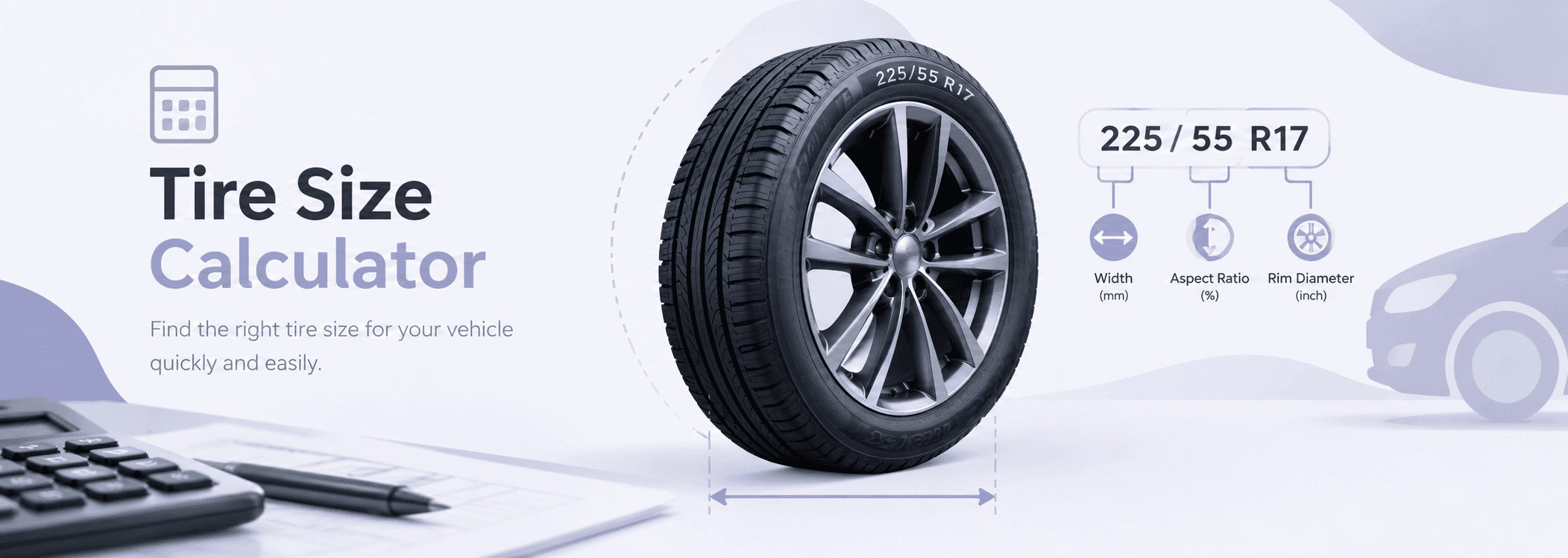
Your tire’s sidewall says something like 225/45R17. These numbers aren’t just for buying tires. If you change the size, they’re what determines whether your speedometer is wrong, your tire hits your fender, or your fuel economy. In this article, we’ll decode the numbers, and use the calculator at the top of the page to test each size change before you buy.
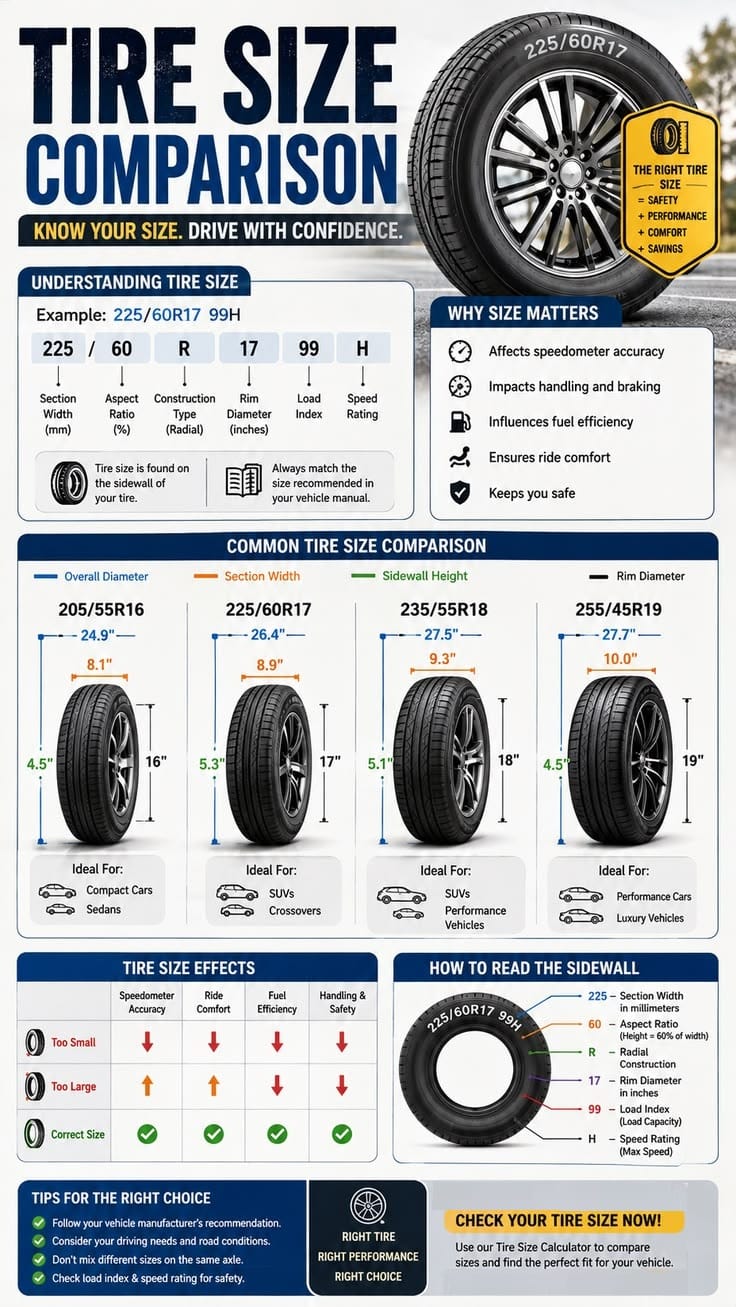
Decoding the size: Example 225/45R17
225: Tire width in millimeters (section width)
45: Aspect Ratio; This means that the wall height is 45% of the width
R: Radial construction
17: Rim diameter in inches
So the wall height is 225 × 0.45 ≈ 101 mm.
Formula for overall tire diameter
Overall diameter = (Rim diameter × 25.4) + 2 × Wall height (all in millimeters)For the example above: (17 × 25.4) + 2 × 101.25 ≈ 634 mm, which is about 25 inches. The calculator will do the same calculation for both sizes and show the difference.
Why is the diameter difference important?
Because the speedometer and ABS calculate based on the number of revolutions of the wheel. If the diameter of the new tire is smaller, the wheel will spin more and the speedometer will show a higher than actual speed. If it is larger, the opposite is true: the actual speed will be higher than the number you see and you may be fined. Rule of thumb: Keep the diameter difference below about 3%.
🛞 Tire Size Calculator
Compare two tire sizes and see the real effect on diameter and speedometer.
| Current | New | Difference | |
|---|---|---|---|
| 📐 Overall diameter | |||
| ↕️ Sidewall height | |||
| ↔️ Section width | |||
| ⭕ Circumference | |||
| 🔄 Revolutions per mile |
Rule of thumb: keep overall diameter within about 3% of the original to avoid speedometer, ABS and gearing issues. Always check clearance and load rating too.
Practical example
Swapping from 225/45R17 to 245/40R18 keeps the overall diameter roughly the same, as the larger rim is compensated by the shorter sidewall. However, swapping from 225/45R17 to 225/40R17 reduces the sidewall height and the diameter is about 2.5%. With the speedometer showing 60 mph, the actual speed will be about 58.5.
Impact of the size change on driving
- Shorter profile: more precise steering and sportier appearance, but a stiffer ride and risk of rim damage in a pothole
- Wider tire: more grip on dry land, but higher fuel consumption and noise
- Narrower tire: lower consumption and better performance in snow, with less grip when cornering
Important tips before changing size
- Check the rim width. Each tire size is only allowed on a certain range of rim widths.
- Check the fender and shock absorber clearance. A wider tire may fit perfectly on the steering wheel.
- Observe the load and speed ratings. It should not be less than the manufacturer’s value.
- Read the vehicle’s permissible size on the sticker inside the driver’s door or in the handbook.
- Replace all four tires with the same size, especially on four-wheel drive vehicles.
FAQs
Can I put on a wider tire?
Usually yes, as long as the rim is the right width and the tire doesn’t touch the fender. Use a calculator to check the total diameter.
How much difference in diameter is allowed?
Usually up to about 3%. More than that can cause problems with the speedometer, ABS, and transmission.
What is the profile ratio?
That is, the height of the tire’s sidewall is a percentage of its width. A lower number means a shorter sidewall and sportier handling.
How does changing the size affect the speedometer?
If the diameter is smaller, the speedometer will read more than it actually is. If it is larger, it will read less. The calculator will show the actual speed.
Does changing the size affect fuel economy?
Yes. A wider, heavier tire usually increases fuel economy slightly.
Before buying any new tires, enter your current size and the size you want into the calculator and see the difference in diameter. This takes a few seconds and will prevent you from buying the wrong tire.